
It's time for the Family Therapy Basics (FTB) Annual Reader Survey!
Once per year, I ask you, the readers, to share with me who you are, what you care about, and how I can be most helpful to you on your therapist journey.
And, I wait on the other end of the internet to see your responses.
Then, I listen and adjust what I'm doing based on your feedback.
Whether you're an occasional FTB website visitor, or a weekly blog email subscriber, I want to hear from you!
This year's survey is a 15-question survey (mostly multiple-choice) that will take only a few minutes to complete. By answering these brief questions, you are providing me with valuable information about what is most meaningful to you in work and life. I, and my team, work hard to offer information and services that meet your therapist needs, and it all starts here--with the annual survey.
A few details about the survey, and what we do with the information:
Your participation and answers are anonymous.
I review each response carefully.
I share the general results on the FTB blog within one month of the survey closing.
We use your responses to develop articles, free library resources, and services that will meet you where you are right now.
>>> Take the survey now, by clicking here. (The survey will close on Tuesday, September 11th, at 8 AM ET).
Thank you!
Let's Chat
Please let me know your thoughts on the survey in the comments, below.
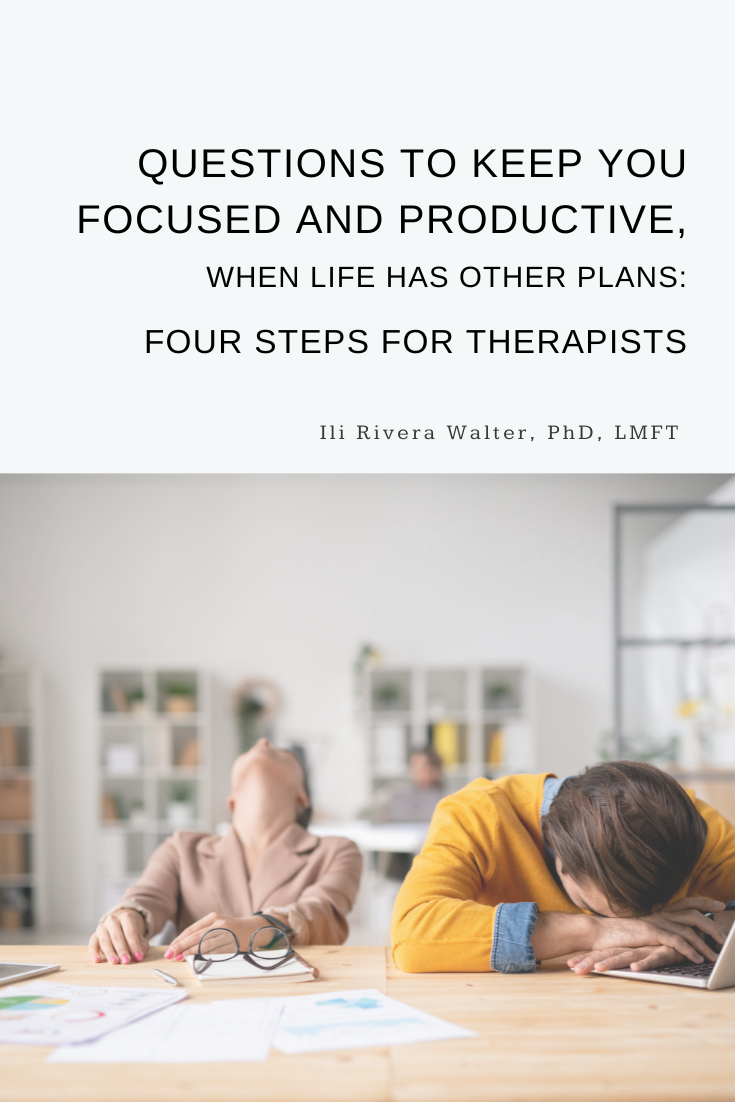
Last year, I went through some personal situations that left me feeling, at times, at the mercy of events that were out of my control. As a result, I often felt frustrated—blocked from the things that I wanted to do, by my circumstances. This led to a sort of snowball effect that generated ongoing tension between my desires and my present responsibilities. (Have you ever gone through a similar season?)

When one or both partners in a relationship have trauma, it can adversely affect the relationship. Relationship satisfaction is lower and marital divorce and separation is higher in those who experienced childhood traumas such as physical or sexual abuse, physical attack, or assault (Whisman, (2006). Results from a study by Riggs (2014) suggest that trauma experienced in adulthood can also adversely affect relationships, and that this effect is compounded if both partners have experienced trauma. As a couple therapist, these statistics can be daunting, as they point toward a need to help members of a couple resolve their trauma while addressing relationship issues.

For decades, we have heard about the “war on ob*sity.” Alongside that rhetoric, we have witnessed, been complicit in, or helped to fund the creation of what is now a $4.2 trillion worldwide wellness industry (Wellness, 2018).
But a fat body – a term used descriptively and in recognition of the fact that “ob*sity” is an arbitrary designation at best (Singer-Vine, 2009) and a pathologizing slur at worst – does not in and of itself warrant this veritable economy of body transformation. In fact, research has shown both that body weight is a poor indicator of health and that people can achieve good health at many different sizes (Bacon & Aphramor, 2011).

Pankaj Gupta, CEO of iPlum, joins me for this post. I interview him about iPlum’s mission, the services the company offers, as well as why iPlum is the right fit for therapists in private practice.
If you haven’t already read Part 1 of my partnership with iPlum, see the five benefits of using a HIPAA-compliant phone solution.

Vicarious trauma is a term that is not unfamiliar to most therapists. Many of us were warned about VT in grad school, have attended self-care workshops that promised to resolve the effects of VT, or have simply resigned ourselves to white-knuckling it through each day. But do you really know how to identify vicarious trauma? Can you pick up on sneaky warning signs that VT is already present in your life?

More and more, therapists in private practice are choosing to have a hybrid or a fully virtual practice. And, as a result, technology, confidentiality, and compliance (and how these three components of business interact), have become more significant factors in our day-to-day work as therapists.
My own path to moving my therapy clients online began in 2014. At that time, I knew no therapists who were practicing online, and I knew even less about methods for streamlining my client communication. I began with a Google Voice number, and over the years developed a fully online practice with what I consider to be the best systems for my group practice.
In my group practice, I sometimes create trainings on relevant topics for my staff, especially when I see an increase in a specific presenting problem for our clients, and/or I recognize an opportunity to expand our services.
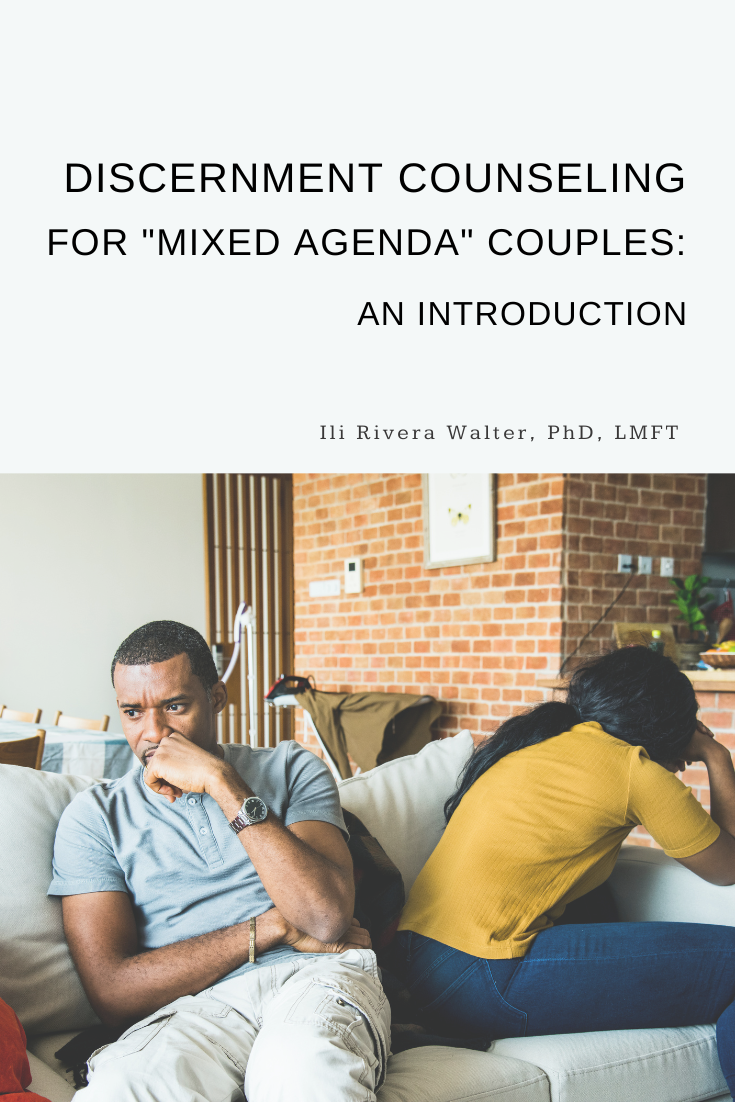
Recently, I offered a training on discernment counseling, a pre- couple therapy approach, developed by Bill Doherty and Steven Harris, for helping couples who are presenting with mixed agendas; that is, one partner wants to work on the relationship, or is “leaning in,” and one partner is not sure, or is “leaning out.”
Recently, I published two articles on the topic: Reasons why therapists are leaving the mental health field. In them, I covered ten of the most common reasons therapists are choosing to change their career path. (If you’d like to read those posts, here are the links to part one and part two.)
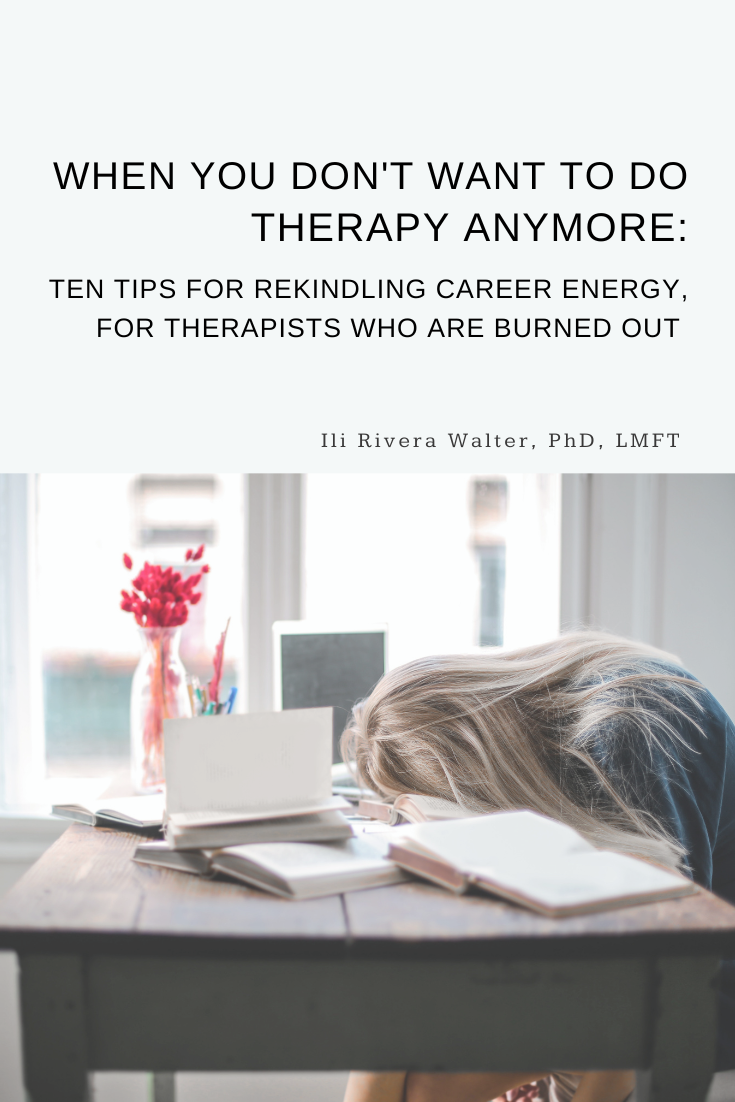
There are many therapists who are living through challenges in their work and career, and yet have not chosen to, or do not want to, leave the field. If this describes you, then keep reading for ten steps that will help you rekindle some career energy.
In this post, I continue listing reasons why therapists are considering leaving the mental health field, because there are many. And, if you are one of the therapists considering leaving the field, please know: You are not alone. If you missed the first post on this topic, head here, and read that first.
Each week, I coach at least one therapist who mentions that they are considering leaving the therapy field. This sentiment seems to have increased among psychotherapists in the past two years with challenges related to COVID (for therapists and clients), including a) sickness, b) working from home, c) relational and family transitions, among others.
Of course, each therapist has their own particular reasons for their desire to leave their profession. Also, from my interaction with thousands of therapists each week, I have noticed several common challenges emerge in conversations about leaving the field.

During a recent Refreshed Therapist Network Q+A, I was asked by a participant, “How do you do it all? You are so prolific!”
My answer? I do what I feel inspired to do in the moment.
However, I don’t do it all! There are months when I am not able to write a post for this blog, because I must focus on my professor job. And, there are months when I don’t create new resources or events, because I put more focus on my personal roles.
The point is, you can produce enough content to become known for your expertise, without keeping a rigid, or pressuring content schedule.
This summer, I reviewed recent research in the field of marriage and family therapy. In this post, I include a brief summary of several articles and one book that I read—all on the topic of romantic relationships and relevant for couple therapy. The articles are from the July 2024 issue of the Journal of Marital and Family Therapy.