• Home
  • Blog
  • Free Library
  • Contact
Menu

Family Therapy Basics

1830 North University Drive
Plantation, FL, 33322
Phone Number
Save Time and LOVE Your Work

Your Custom Text Here

Family Therapy Basics

  • Home
  • Blog
  • Free Library
  • Contact

On Being a Therapist in Life and Work: Two Areas to Observe

January 3, 2017 Ili Rivera Walter, PhD, LMFT
On Being a Therapist Blog Graphic.png

This post is a reflective response to the article, "The Effects of Practicing Psychotherapy on Therapists' Personal Lives," by Shannon Peterson


Recently, I read an article summarizing a Norwegian study on how practicing therapy impacts therapists' lives.  I found the article extremely valuable.  Many points in the article validated my therapist experience, and I'm sharing them with you today in the hopes that they will validate your experience, too.

Two themes from the article reminded me of the importance of maintaining perspective as a therapist.  We can get busy living our lives and doing our work, and forget that our responses and emotions are a part of a larger context.  That larger context includes our professional developmental stage as well as how we transfer between professional and personal roles.

1 |  Developmental Stage

"Research has also shown that the impact of being a therapist differs depending on career stage.  Trainees often report positive personal effects due to gaining more self-awareness, whereas mid-career clinicians tend to focus on the stress created from their jobs. Senior therapists are more likely to focus on the ways their role as a therapist has facilitated personal growth" (Peters, 2016).

This point emphasizes the changing impact and meaning of our work based on our professional developmental stage.  While the participants of the research study were senior therapists, the information provided by this study can contribute to novice therapists' ideas about what it means to be a therapist, as well as their sense of ownership over their professional paths and identities.  It's important for trainees to understand that they may not always have the same feelings about their work that they now have, and for mid-career professionals to know that they may, in the future, feel grateful for how their work has influenced their personal development. 

Senior therapists, instructors, and supervisors can use this information to help train and encourage future therapists (and each other!) on the lifespan of the therapist profession as well as its common experiences along the timeline.  This can help normalize and contain therapists' challenges and emotions.  Perhaps knowing this information as we enter and remain in the therapy field can lead to increased awareness about, and therefore longevity in, our field.

2 |  Finding Balance?

"According to the researchers, the 'concept of work–life ‘balance’ did not offer a satisfactory way of understanding the way that therapists learn to manage their lives.'  Instead, the researchers describe how clinicians 'acquired a capacity to exist in parallel realities, and that one of the ways in which they accomplished this was to co-construct, with others in their lives, a set of practices that enabled them comfortably to move across contexts, such as the shift between work and home” (Peters, 2016).

This was one of the most striking themes in the research.  I appreciate the concept "parallel realities," and the idea of co-constructing the "shift between work and home."  These two aspects of the therapist life merit their own study!  For example, I'd love to know: 

  • What are specific strategies that therapists (as compared to other professionals) use to "co-construct" their lives with their significant others, in particular, "the shift between work and home"? 

  • What does it mean to exist in parallel realities?  This implies separate trajectories that do not cross.

    • Do all professionals exist in parallel realities?  If so, how are therapists' parallel realities unique?

    • What are the benefits or consequences of living this way?

    • How is this an accurate or inaccurate way of describing how therapists maintain boundaries and honor separate contexts?

  • What type of practices help therapists shift contexts?

I ponder these points recognizing that most of us shift in and out of co-construction as well as awareness of the need for co-construction.  Perhaps we go silent and inward for periods of time.  We also may struggle in our work and life, partly because we have lost sight of how to shift within and between our contexts.  Despite these challenges, many of us can answer the questions posed above based on our therapist experience, because we hold these questions daily.  The therapist life requires much from us, and sometimes, we want to shut off the requirements.  Other times, we welcome them.

This research points to a fact that many of us therapists already know, because it is our daily truth:  Our work and our lives cannot be separated.

The importance of this type of research is that it presents us with information that can guide us in searching for ways to talk about our distinct profession and the way it blends with our lives and identities.  It also emphasizes the importance of searching for and figuring out our specific responsibilities to our "parallel" contexts, so that we can be transparent about our experiences as therapists with ourselves, our loved ones, our colleagues, and the public.

Summary

The therapist life holds unique challenges and rewards.  The research that inspired this post reminds us that in order to live honestly with ourselves and our significant others, we can invite our many contexts and perspectives into discussions about what it means to be a therapist personally and professionally.  


Let's Chat

Let me know in the comments below:

  • What is the most challenging aspect of "shifting contexts," or blending your work and life?

  • I invite you to tell me how I can best serve you.  Sign up below!


References

The original research study abstract can be found here:  How does practicing psychotherapy affect the personal life of the therapist? A qualitative inquiry of senior therapists’ experiences


RELATED POSTS
How to Keep Your Therapy Communications Secure, While Working Remotely: An Interview with iplum CEO Pankaj Gupta

Pankaj Gupta, CEO of iPlum, joins me for this post. I interview him about iPlum’s mission, the services the company offers, as well as why iPlum is the right fit for therapists in private practice.

If you haven’t already read Part 1 of my partnership with iPlum, see the five benefits of using a HIPAA-compliant phone solution.

Read more →
5 Ways Vicarious Trauma Can Sneak Up on You as a Psychotherapist

Vicarious trauma is a term that is not unfamiliar to most therapists. Many of us were warned about VT in grad school, have attended self-care workshops that promised to resolve the effects of VT, or have simply resigned ourselves to white-knuckling it through each day. But do you really know how to identify vicarious trauma? Can you pick up on sneaky warning signs that VT is already present in your life? 

Read more →
When You Don’t Want To Do Therapy Anymore: Ten Tips for Rekindling Career Energy, for Therapists Who Are Burned Out

Recently, I published two articles on the topic: Reasons why therapists are leaving the mental health field. In them, I covered ten of the most common reasons therapists are choosing to change their career path. (If you’d like to read those posts, here are the links to part one and part two.)

There are many therapists who are living through challenges in their work and career, and yet have not chosen to, or do not want to, leave the field. If this describes you, then keep reading for ten steps that will help you rekindle some career energy.

Read more →
Five More Reasons Why Therapists Are Leaving The Mental Health Field

In this post, I continue listing reasons why therapists are considering leaving the mental health field, because there are many. And, if you are one of the therapists considering leaving the field, please know: You are not alone. If you missed the first post on this topic, head here, and read that first.

Read more →
Five Reasons Therapists Are Leaving the Mental Health Field

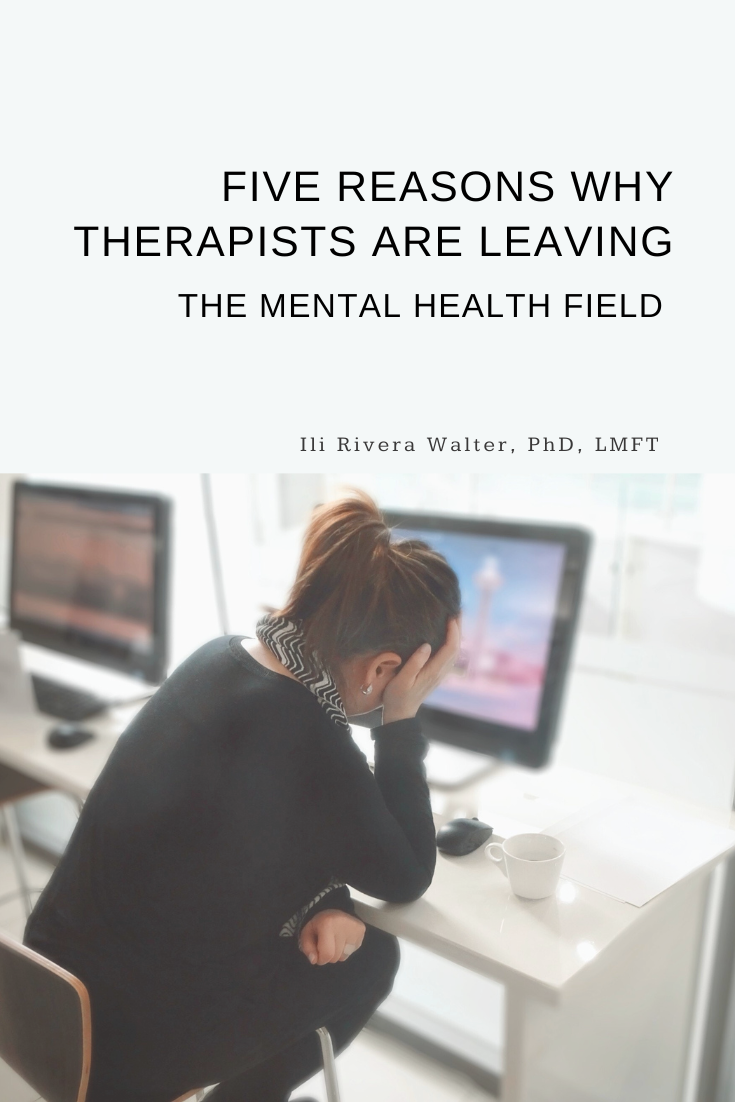
Each week, I coach at least one therapist who mentions that they are considering leaving the therapy field. This sentiment seems to have increased among psychotherapists in the past two years with challenges related to COVID (for therapists and clients), including a) sickness, b) working from home, c) relational and family transitions, among others.

Of course, each therapist has their own particular reasons for their desire to leave their profession. Also, from my interaction with thousands of therapists each week, I have noticed several common challenges emerge in conversations about leaving the field.

Read more →
How to Find and Live The Refreshed Therapist Life

As a clinical supervisor and consultant to therapists, I meet many clinicians who find themselves burned out, bored, or numb after years of showing up for their clients, and neglecting, to some degree, to show up for themselves. The reality of our work is that in order to sustain and enjoy it, we must intentionally deal with the nuances of what it means to function as a therapist inside and outside the therapy room.

As therapists, we have the opportunity to be vocal about the ways we live out the intersection of life and work. Our voices generate more expansive and encouraging conversations that can lead to a sense of flow in navigating our personal and therapist selves.

Read more →
How To Engage In Social Media Self Care: Eight Steps For Therapists

Social media posting is a must if you’re a therapist marketing a private practice. Even if you’re not a business owner, you may find that your social media is taking up more time than you’d prefer (gentle nudge: How’s your screen time report looking this week?).

Hey—like therapy, this is a judgment-free zone. It is also a “let’s be our best selves” zone. And, to show up as our best selves, self care is essential.

Read more →
Technology-Assisted Clinical Supervision: Benefits, Challenges, and Regulations

If you’re a clinical supervisor navigating the delivery of supervision right now, you may have encountered some challenges, including state, institutional, and technological limitations. The information I present in this post is intended to encourage the legal and ethical use of technology-assisted (distance) supervision in a variety of settings.

Dr. AnnaLynn Schooley and I recently discussed this subject as it relates to our experiences and our development as supervisors. Dr. Schooley is a LMFT and LMHC in the state of Florida, and carries licenses in additional states. She serves as a supervisor for master and doctoral-level MFT students in her role as professor for Capella University.

Read more →
Start on Time, End on Time: HOW TO MANAGE Your Private Practice THERAPY Sessions

Whether you’re 6 or 60, there’s one thing everyone hates when going to the doctor; and no, it’s not getting pricked with needles. It’s waiting to get pricked with needles. Your appointment is at 2, but as 2, 2:05, 2:10 rolls by, you ruminate “I had an appointment. If the doctor wasn’t going to be available, why schedule at this time? Apparently, my time isn’t valuable.”

As our lives are perhaps more rushed than ever, waiting for any appointment or meeting is a hassle. However, a tardy counseling session is qualitatively worse than other late meetings. Getting started late is a broken promise in a relationship that needs trust in spades.

Read more →
The Problem With Loving Your Work: The Role Of Expectations, Wages, and Passion

Recently, I’ve been thinking about the role of work in my life, as well as how I relate to work. This train of thought naturally leads to evaluating how well I am doing engaging with people (and myself) as more than a worker.

How much time and mental energy does my work take from me, or give to me?

How much of my drive and motivation does my work inspire?

These are a few of the questions I am asking in order to continue my mission for myself and other therapists: To live and work well.

Read more →
Three Ways to Be A Leader Who Lasts

What does it take to be a leader? Thousands of words have been written on the topic. Here’s the truth: there’s no magic formula.  But I do suggest three important elements to work on over time: Know yourself, know your purpose, and know your people. How to live that out will differ for every leader and every setting.

Read more →
Mindfulness Tips for Therapists, for Work and Life

Mindfulness is popular.

You likely have worksheets, lessons, techniques, and theories that help your clients understand mindfulness and its benefits.

You understand mindfulness and its benefits.

But, as we therapists know, sometimes understanding doesn’t foster motivation, or change. The fact is, therapists struggle to implement mindfulness, along with a “self-caring” lifestyle (Kissil and Niño, 2017).

Read more →
In therapist
← Living Refreshed As A TherapistFamily Therapy Basics: A Year In Review →
Interested in information that clarifies, simplifies, and enhances your therapy work? You're in the right place. Learn more . . .

Interested in information that clarifies, simplifies, and enhances your therapy work?  You're in the right place.  Learn more . . .


S A Y H E L L O


S U P P O R T T H E B L O G

DONATE ANY AMOUNT

B L O G S P O N S O R S

Thera-link | Family Therapy Basics

A F F I L I A T E S


P O P U L A R  P O S T S

Blog
10 Therapist (and Child)-Approved Activities to Support Kids with Anxiety

If you’re a mental health professional working with children, you will probably agree that many of the calls you receive from parents have something to do with anxiety or stress. Child therapists have the amazingly important yet challenging task of educating and supporting kids in a therapeutic setting that is both productive and fun. When working with children as young as preschool age, it can be a very daunting task to keep things fresh and exciting week after week! So, how do we help children develop the coping skills they need while keeping them engaged (and not glancing at their watch)? Here are ten therapist (and child!)-approved, fun activities that address anxiety-based disorders and promote relaxation and stress reduction in children:

Read more →
The Art and Science of Therapy as Craft, Part 2:  Crafting Questions
The Art and Science of Therapy as Craft, Part 2: Crafting Questions

For this week's video chat, Dr. AnnaLynn Schooley returns to discuss therapy questions as an intentional craft, and she covers four basic question types:  single answer, open, closed, relational, and circular.

Read more →
Therapist Self-Disclosure Simplified

Self-disclosure is a touchy subject among therapists. Some therapists never self-disclose, while others feel stifled by having a rigid boundary around self-disclosure.  As I consider self-disclosure in therapy, I ask myself, “When is self-disclosure appropriate?”  “How does self-disclosure deepen the therapist-client connection?"

Read more →
Solution Focused Brief Couples Therapy Tips, with Elliott Connie

Elliott Connie is a Solution Focused Brief Therapy (SFBT) practitioner, author, and speaker.  He developed an approach to couples work that distills the essence of SFBT into guiding principles for working with couples. 

As a therapist who loves working with couples, I am always interested in ways to enhance my couples therapy skills.  For this reason, I invited Elliott to explain the reasons why SFBT is his choice for working with clients, as well as how it creates a contrasting experience for couples that have a history in therapy.

Read more →
Family of Origin Exploration for the Therapist:  How to Create Your Genogram
Family of Origin Exploration for the Therapist: How to Create Your Genogram

In article three of the Family of Origin for the Therapist series, you learned 3 simple steps for how to begin family of origin (FOO) exploration:  1) read Bowen’s chapter, 2) observe your FOO experience, and 3) reflect on what you learned. Hopefully, your curiosity has led to significant understanding.

Understanding is the foundation of Bowen Family Systems Theory (BFST). Bowen (1985) believed that if clients could understand themselves as members of their FOOs and as created by their histories, they could begin and continue significant change. 

In today’s post, I offer the next step in developing understanding:  Creating your genogram. I explain how to create a basic genogram that you can expand as you continue your exploration.  

Read more →
5 Tips for Keeping Up with Therapy Paperwork

In my interaction with therapists as a mentor and supervisor, I’ve learned that one of the main struggles therapists face is having too much work and not enough time. Many therapists find themselves overwhelmed by documentation responsibilities, in particular; this includes completing client notes, referrals, billing, treatment plans, etc.

In today’s post, I offer several strategies for keeping up with paperwork, so that you can stay on track and avoid the stress of falling behind.

Read more →
Solution-Focused Brief Therapy Client Types, and Their Relevance To Every Session

In her 1989 article, Of Visitors, Complainants, and Customers, Insoo Kim Berg details three types of “client-therapist relationships” (p. 21). Her wording is significant, because she is not labeling clients; she is describing them in terms of their relationship to the therapist, the process of therapy, and the problem. These three relationships have undergirded Solution-Focused Brief Therapy theory and interventions over the years, although they are not consistently discussed in newer works. The client relationship types are widely applicable to therapy, regardless of theoretical orientation, making them one of the most useful concepts in marriage and family therapy.

In this post, I present a review of these client types, and I explain their relevance to and usefulness for all therapeutic sessions.

Read more →
How to Ethically Offer Coaching as a Licensed Therapist:  A Step-By-Step Guide
How to Ethically Offer Coaching as a Licensed Therapist: A Step-By-Step Guide

One of the most common professional goals for my clients is expanding their private practice to include life coaching services. As professionals with a depth of knowledge in personal development and goal achievement strategies, therapists are ideal candidates for the coaching profession. Despite this near perfect fit, there are some important ethical consideration for therapists when offering coaching services alongside therapy, or when choosing to become professional coaches. In this post, I focus on offering solutions for these complications, in an effort to help you ethically practice coaching.

Read more →
5 Step Plan for De-escalating an In-Session couple Argument

Most of us, therapists, have been there:  A simple disagreement turns into an all-out screaming match in the middle of a therapy session. This is, thankfully, not a common scenario for most therapists, but it’s also not rare--especially for therapists who specialize in couple therapy.

In this post, I cover steps for disrupting an argument occurring in a couple therapy session. Intervention on the part of the therapist is necessary during some conflicts, because the arguments can cause further damage in the couple relationship. And, if therapists allow arguments to continue for too long, they can affect the couple’s sense of safety when in therapy.

The main goals of intervention in this case are to:

Read more →

#5 on Feedspot's Top 40

 Family Therapy Blogs

T O O L S  WE  L O V E

SEE THE LIST

I N S T A G R A M

@driliwalter

I was speaking with a couple this week, and the wife explained that she retaliated toward her husband, because she wanted him to feel the way she feels when he does the same thing to her.

Of course, when we feel unheard, we will result to desperate
Focusing on changing our partner is a waste of energy. We can make requests and express our desires, but when this turns into consistent criticism, it harms everyone involved.

Oftentimes, wanting to change another stems from our own unhappiness. Ins
Sure, it makes sense that when spouses are best friends, the first thing we wonder is if they are isolating from having interests outside their relationship. In reality, many couples who are each other's best friends do enjoy separate activities and
Safe connection is a gift that heals us. ♥️
@realterryreal

COPYRIGHT 2016, FAMILY THERAPY BASICS | ALL RIGHTS RESERVED

ABOUT SUBMISSIONS PARTNERSHIPS

copyright © 2016-2025 | Family Therapy Basics | All Rights Reserved | Legal, Privacy, + Disclaimer | Site Credits, Affiliations, + Stuff